
Zero Recall Risk: How Msxtoys Approaches Small Parts Compliance

For global toy brands, a recall over choking hazards isn’t just expensive—it can mean delisting from major retailers and years of rebuilding trust. As a custom plush toy manufacturer serving brands like the UK’s Next, we take a different approach. Instead of treating safety testing as a final checkpoint, we build toy safety compliance into the product from the first design sketch.
Every OEM plush toy we manufacture is held to the Small Parts Cylinder Test (16 CFR Part 1501) and the 15-lbf Tension Test required under ASTM F963 and EN 71-1. For clients requiring Bureau Veritas (BV) certification, we manage independent testing as part of our standard workflow. The following outlines how our QA protocols eliminate choking hazard risks before production starts.
1. What a Recall Actually Costs
In the global toy market, the most common cause of product recall is small parts detaching from plush toys—especially eyes, noses, and fasteners. For brands selling through Amazon, Target, or other major retailers, a single safety failure can result in chargebacks, delisting, and a long, expensive road back to compliance. CPSC-certified production isn’t optional; it’s the price of entry.
When brands work with us, they’re not just contracting manufacturing capacity. They’re relying on an OEM plush toy factory with a supply chain structured to meet—and in some cases exceed—the safety standards that retail compliance teams actually enforce.
2. The Standards That Matter (and Why They’re Not Optional)
-
The Small Parts Cylinder (16 CFR § 1501.4)
Under CPSC rules, any toy intended for children under three cannot contain—or shed—any piece that fits entirely into a cylinder with a 1.25-inch (31.7 mm) interior diameter. That cylinder approximates a young child’s airway. If a part fits, it’s a fail. Passing the small parts test is non-negotiable for US customs clearance.
(🔗 Source: CPSC Small Parts Regulation) -
The Tension Test (ASTM F963 / EN 71-1)
Attached components like eyes and noses must withstand a steady pull of 15 lbf (70 N in the EU) for ten seconds without coming off. The test is designed to simulate what happens when a child pulls, chews, or yanks on a toy. ASTM F963 compliance and EN71 certification are baseline requirements for North American and European markets.
(🔗 Source:ASTM F963 Standards)
These aren’t just paperwork requirements—they’re what retailers and customs brokers actually verify.
3. How We Structure Safety Into Production
We operate on a simple premise: children are the most destructive testers you’ll never meet in a lab. So instead of relying only on end-of-line QC, we remove the risk earlier.
A. Design-Level Risk Reduction
For toys intended for children under three, we actively recommend moving away from attached plastic parts.
-
High-density embroidered eyes become the default for facial features. This eliminates choking hazards entirely—no glue, no washers, no detachment risk.
-
If a client’s design genuinely requires a hard plastic accessory, we focus on base diameter control. We make sure the internal base of the component is significantly larger than the 1.25-inch cylinder opening. Even if the fabric around it fails, the detached piece physically cannot fit into the test cylinder.
B. Fastener Engineering (No Glue-Reliance)
We don’t use basic glue or simple flat washers for eyes and noses. Both degrade over time, especially with washing or repeated stress.
-
Instead, we use barbed nylon safety locking washers on all plastic accessories. These washers have a one-way locking structure. Once pressed onto the post inside the plush, removal requires destroying the fabric itself—not just overcoming glue adhesion.
-
For rigid accessories that need extra security, we use ultrasonic welding. The plastic component is fused directly into the fabric layer at a structural level, creating a bond that easily exceeds the 15-lbf pull test requirement.
C. 100% In-Line Pull Testing
Random sample testing catches problems after they’ve already happened. We run pull tests differently.
On the assembly line, every plush—not a sample—has its eyes, nose, and other attachments tested for tension before moving to the next stage. We calibrate to a higher internal threshold than the standard requires. If a component doesn’t hold, it doesn’t move forward.
4. Independent Testing: How We Handle Third-Party Labs
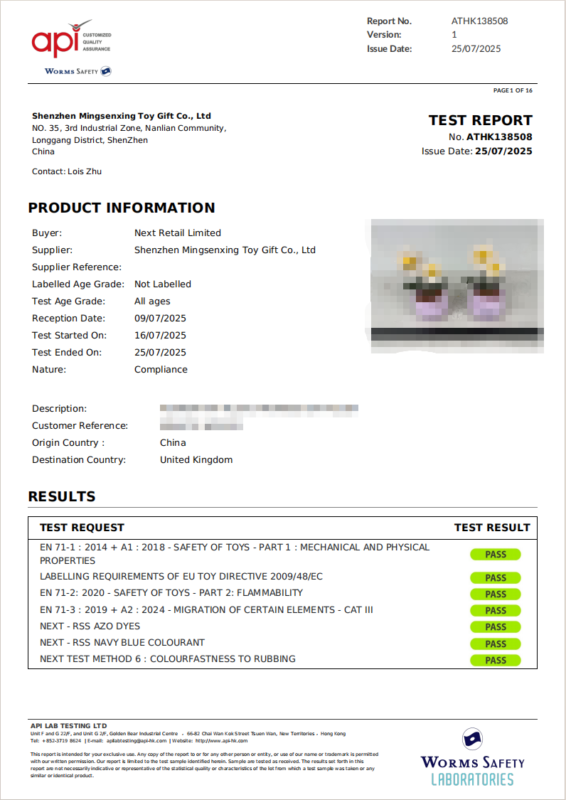
Internal testing catches issues early. But for retail compliance, independent lab reports are non-negotiable. We manage the entire testing coordination process so brands don’t have to.
-
Bureau Veritas (BV) – Next (UK High Street Retailer)
The UK and European markets have some of the strictest safety standards globally. We are an established Next supplier, and Next mandates Bureau Veritas for their compliance testing. This means our production lines and QA teams are already optimized to pass BV protocols on the first run. If your brand requires BV certification, we’ve already done it. -
SGS & Intertek
These are the global gold standards for North American toy safety testing. We routinely manage testing submissions with both labs, ensuring rapid customs clearance for US and Canadian markets. SGS-tested and Intertek-certified products are what major retailers expect. -
CTI (Centre Testing International)
For emerging brands that need a cost-effective testing solution without compromising on legal compliance. CTI is fully CNAS-accredited and CPSC-accepted. Using CTI, we help lower testing overhead while still delivering legally binding safety reports.
We don’t just hand off samples to a lab and wait. We coordinate submissions, pre-test internally against the same protocols, and troubleshoot any failures before they become your problem.
5. How Our Approach Compares
| Area | Common Factory Approach | Msxtoys – Premium OEM Standards |
| Design Phase | Follows client drawings as-is | Adjusts base diameters; recommends embroidered eyes for under-3 products |
| Attachment | Glue or basic flat washers | Barbed nylon safety locking washers; ultrasonic welding for rigid parts |
| Quality Control | End-of-run random sampling | In-line 100% pull test on all attachments |
| Lab Support | Leaves entirely to buyer | Full coordination with BV, SGS, Intertek, or CTI |
| Standard | Varies | CPSC certified, ASTM F963, EN71 |
6. Why This Matters for Your Brand
When you import OEM plush toys, liability sits with you—the brand. Retailers don’t issue warnings before removing a non-compliant product. They issue chargebacks.
Our approach isn’t about marketing claims. It’s about structuring production so that product recall risk is eliminated before it becomes your problem. We’re regularly audited by third-party labs and welcome any inspection—because we build toys that are meant to pass customs and pass retail audits.
Launching a new plush line?
We can review your current design files and flag potential small parts test risks before sampling begins.
👉 [Contact Msxtoys Engineering for a Pre-Production Safety Review]